Introducing LICA: A Dataset of 1.5M Layered Graphic Design Compositions
Elad Hirsch, Shubham Yadav, Mohit Garg, Purvanshi Mehta
TL;DR
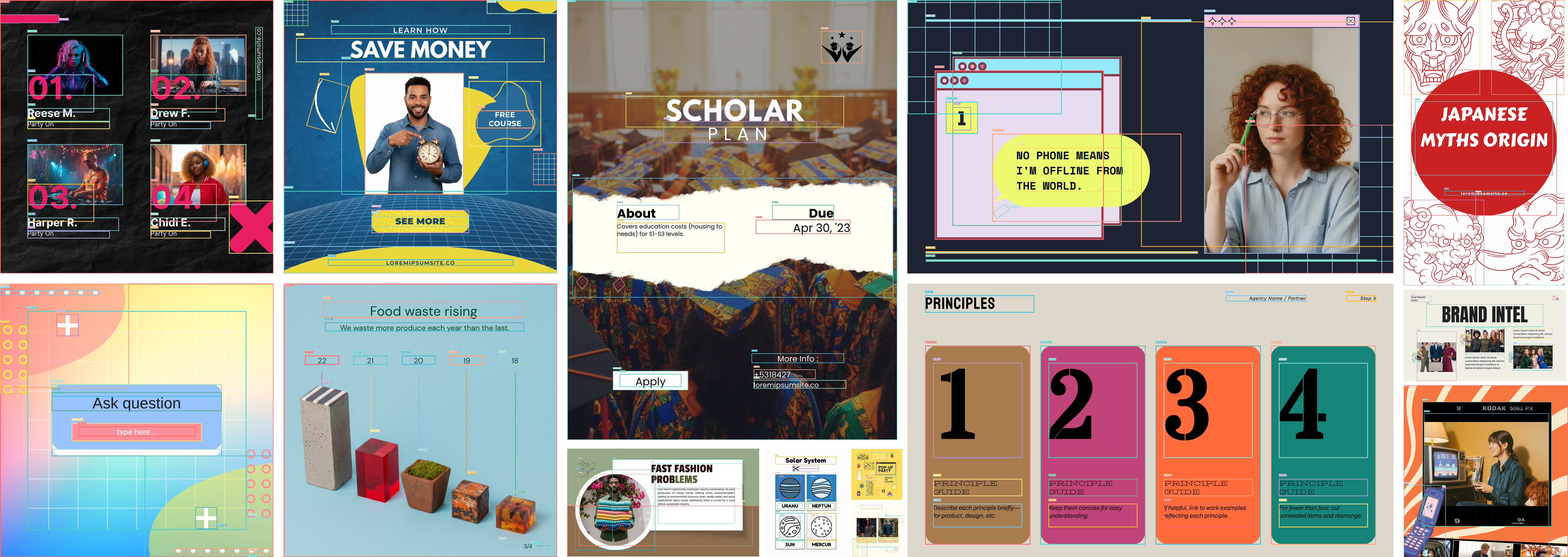
We're releasing LICA (Layered Image Composition Annotations), the largest graphic design dataset to date: 1,550,244 multi-layer compositions across 20 categories, with full compositional hierarchy, per-element style metadata, and a novel animated layout modality. LICA is an order of magnitude larger than existing datasets and enables tasks like layer-aware inpainting, structured layout generation, and temporally-aware generative modeling.
LICA stands for Layered Image Composition Annotations. It is a large-scale dataset of 1,550,244 multi-layer graphic design compositions with full compositional structure. Each sample is represented as a hierarchy of typed components (text, image, vector, and group) paired with rich per-element metadata including spatial geometry, typographic properties, opacity, and visibility.
Category Samples from LICA
Below are representative samples drawn from the top categories in dataset. Select a category to see its rendered composite alongside the full LICA config and the original user intent that generated it.

Dataset Statistics
| Metric | Value |
|---|---|
| Total compositions | 1,550,244 |
| Design categories | 20 |
| Unique templates | 971,850 |
| Animated layouts | 27,261 |
| Component types | Text, Image, Vector, Group |
A New Modality: Graphic Design Video
Beyond static compositions, LICA introduces graphic design video as a novel data modality. 27,261 animated layouts are included, each with per-component keyframes and motion parameters. This enables a class of tasks that no existing dataset supports: temporally-aware layout generation, motion-consistent editing, and animation parameter prediction.
What's Next
LICA represents an order of magnitude leap over existing graphic design datasets and serves as the foundation for the models we are building at Lica World. By combining large scale compositional structure with rich hierarchical, typographic, and temporal information, it provides the kind of training signal needed to move beyond pixel based understanding toward a system level view of design. This enables AI to reason about layouts as structured, editable compositions, closer to how designers actually work. We see LICA as both a resource and a catalyst for the community, opening the door to new tasks such as structured generation, constraint aware editing, and temporally grounded design modeling, and we look forward to sharing more about the models and capabilities it unlocks in future work.